Loading course navigation
Loading lesson
50 min
Student Lesson
Lesson 2: Building Background Knowledge: What Makes an American?
Content
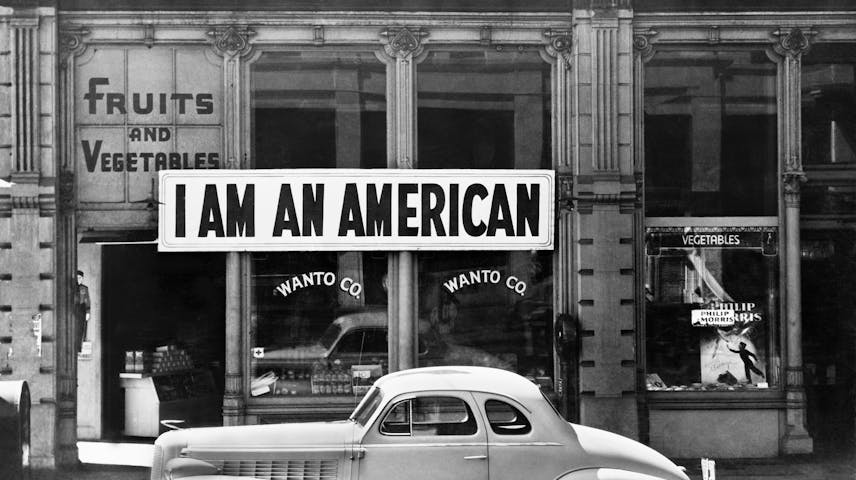
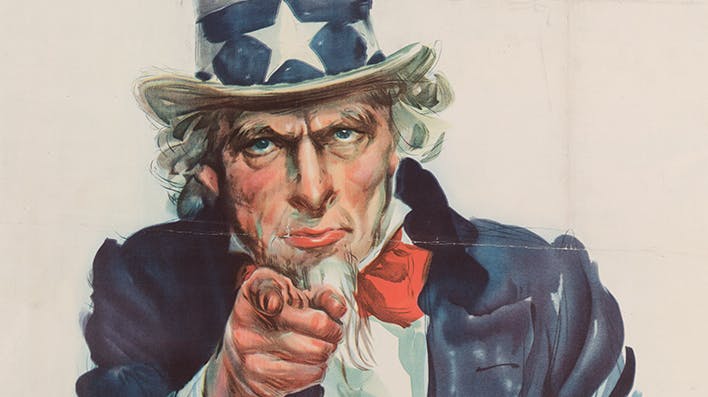
Students will consider the question “What makes an American?” in light of two visual appeals to Americanness: a sign put up by a Japanese American grocer in 1942 and a recruitment poster that predates the United States’ entry into World War II.
Language
Students will analyze how public messages shape perception by interpreting two wartime images (“I Am An American” sign and Uncle Sam poster), using evidence-based language and cause/effect connectors (because, as a result, therefore) plus academic interpretation verbs (suggests, communicates, portrays) to explain how fear can influence how audiences understand “Americanness.”
Foundational Skills
Students will reflect on the many definitions that a political and geographic term such as American can have in different contexts.
How do historical records (texts, images, and testimony) shape what is remembered about the past?
How can readers evaluate words and images for accuracy, perspective, and ethical use?
Knowledge-Building:
The items in this lesson’s Resource Set show the political stakes of defining Americanness and related concepts such as patriotism and loyalty.
Enduring Understanding:
Many Japanese Americans were eager to prove their loyalty to the United States. In this way, they hoped to counter racist and xenophobic narratives about who could be a “real” or “true” American in wartime.
Future Lessons:
Lesson 3 continues the exploration of primary documents and the construction of background knowledge. In Lesson 4, students begin exploring the anchor text with this background in mind.
Unit Performance Task:
In seeking to understand the stories of internment camp survivors, students will benefit from an understanding of the narratives used to excuse the incarceration policy—narratives that were sometimes explicitly promoted, and very often tacitly encouraged, by those in power.
| Lesson Flow | Purpose of Learning Experience |
|---|---|
Launch10 Minutes | Students will summarize and reflect on their observations from the last class with a focus on representation and cultural attitudes. |
Learning in Action35 Minutes | Part A: What Makes an American? (SL.7.1a) Students will review the history of the term American and discuss how the term is, or should be, defined today. Part B: Analyze Media (RI.7.6, RI.7.7) Students will examine two iconic images from World War II: the “I Am an American” sign displayed by Tatsuro Matsuda, whose family owned a grocery store in Oakland, and the Uncle Sam recruitment poster from 1940. They will analyze both pictures in terms of the messages they convey about Americanness. |
Look Back5 Minutes | Students will work together to complete a Check for Understanding question that summarizes their analysis of the two images. |
Not available for this lesson
Not available for this lesson
Material List
Display copies of “I Am an American” sign and Uncle Sam poster
Routines
Turn-and-Talk
Collaborative Idea Board
Check for Understanding
Launch by making connections to what students have learned about American culture and history circa World War II, as well as attitudes toward Japanese Americans during that time.
Say these Directions: Turn and talk with a partner to summarize what you learned from the article and photo set in the last lesson. Then, connect your ideas to this unit’s themes of visibility and exclusion. Use the guiding questions to support your discussion.
Ask: Who appeared in the photos of Americans on the “home front”?
People of all ages appeared in the photos: men, women, teenagers, and young children. They were shown working, shopping, commuting, socializing, and going about their daily lives. Quite a few were in sailors’ uniforms. Most of the photos’ subjects appeared to be white; some were black, and some were specifically identified as Italian American.
Ask: Who was absent from those photos, and why?
I did not see anyone who appeared to be Asian American in the photos. In the case of Japanese Americans, this was likely because they had been “evacuated” from places like San Francisco and forced to relocate to the internment camps. Thus, they would have been absent from day-to-day life in San Francisco and other West Coast cities.
Ask: What do these photos suggest about the American “home front” during the war?
Based on the photos, it seems like Americans largely supported the war effort through things like rationing and buying used goods. The people in the photos seem cheerful and neighborly. Lange does note that the war is changing some cities, such as Oakland, but it is hard to say exactly how from these photos alone.
Say: Today, we will be examining media that deal with what it means to be an American and how people perceived Americanness during World War II. Today’s images will extend some of the ideas from the Lange photographs, such as the link between patriotism and militarism.
Briefly explain the origin and history of the term American for students. Share that the word comes from the name of Italian explorer Amerigo Vespucci, who around 1500 helped show that the Americas were distinct continents from Asia; that the term America appeared soon afterward in an influential map of the world; and that the use of the word as a shorthand for “the United States of America” did not become widespread until the end of the 19th century.
As time permits, introduce the following additional details:
In the 1490s and 1500s, Florentine explorer Amerigo Vespucci (1454–1512) took part in voyages to South America. He wrote about his experiences and helped convince fellow Europeans that the landmass across the Atlantic was not Asia. Vespucci’s writings also introduced the term “New World” (Latin: Mundus Novus) for the Americas.
In 1507, German cartographer Martin Waldseemüller (c. 1470–1520) published a map of the world that gave the name “America” to the landmass across the Atlantic from Europe and Africa. On the map, the label “America” applies to what we today call South America. Waldseemüller stated that this name was chosen to honor Vespucci.
The name “United States of America” entered official usage with the Declaration of Independence, though it was used in correspondence and journalism earlier in 1776.
For more than a century, people in the United States referred to their country as “the United States,” “the Union,” or sometimes “Columbia” (after Christopher Columbus). Only after the Spanish–American War did the practice of calling the country America and its people Americans gain traction.
Today, the term American is widely associated with the United States specifically. However, some people throughout North, Central, and South America object to the use of the word to describe only people who come from, or are citizens of, the United States. This is not a new criticism: part of the reason that earlier generations avoided the term was that many other countries also existed in the Americas.
Say these Directions: Think about the question: What makes an American? Share your ideas as we record them on a Collaborative Idea Board. As we build our ideas together, use the guiding questions to help you think more deeply and contribute to the discussion.
Ask: Do you have to be from America to be an American? Why or why not?
You don’t have to be from the United States to be an American. If you immigrate to the U.S. and become a citizen, then you are legally an American and the other people in this country should regard you as such.
Ask: Are there values and beliefs that define Americans? Do you have to share those beliefs to be an American?
There are values that many Americans hold in common, such as freedom and equality. We even sometimes hear these referred to as “American values.” However, having certain values and beliefs is not what makes a person an American or not.
Ask: Can someone decide to stop being an American? How? Can others decide that someone is no longer an American?
A person could stop being an American legally if they decided to stop being a citizen and become a citizen of another country instead. However, the people in their new home country might still think of them as an American. I don’t think other people should be able to decide that a person is no longer an American.
Teacher Tip |
|---|
To help students recognize the challenges in defining a political or geographic term, consider displaying the definition of American given in a major print or online dictionary. Lead discussion of the multiple senses covered in the definition, the purpose of any usage notes, and what a dictionary definition includes and leaves out. |
Checklist (SL.7.1a) |
|---|
As you participate in the discussion, make sure you:
|
Remind students that in this unit, they will be reading a text titled Seen and Unseen. Discuss what it means to be “seen and unseen” in both literal and figurative senses.
Say these Directions: First, look at the two images from Spark Resource Set #2: the “I Am an American” sign (Oakland, CA, 1942) and the Uncle Sam recruitment poster (1940). As you view them, listen for important historical context that will help you understand each image.
Next, you will work in groups. Half of you will focus on the “I Am an American” image, and the other half will focus on the recruitment poster. With your group or partner, discuss the questions that follow
The “I Am an American” sign was put up in front of a Japanese American-owned grocery store as a show of loyalty and patriotism. Tatsuro Matsuda commissioned the sign for his family’s business the day after the Pearl Harbor attack, when already-widespread anti-Japanese sentiment reached a fever pitch. The Matsudas were forced to relocate under Executive Order 9066, and their business was shuttered and sold.
Uncle Sam has been a personification of the United States since the mid-19th century. The now familiar version of the character, dressed in red, white, and blue and sporting a goatee, dates from the late 19th century. Uncle Sam appeared in many turn-of-the-century political cartoons related to (and often promoting) the U.S.’s colonial exploits of the period. In 1940, with involvement in World War II seeming increasingly likely, the United States Congress authorized a draft that rapidly grew the ranks of the armed forces. Prior to this, enlistment had been voluntary since the end of World War I.
Ask: Why was the image created?
The “I Am an American” sign was created to show patriotism during a time when many Japanese Americans’ loyalty was being called into question. It may also have been a practical move to try to protect the business from vandalism or mob violence.
The recruitment poster was made to encourage young men to join the United States military in the buildup of forces that preceded World War II.
Ask: Who was the intended audience of this image?
The sign was displayed on a specific street in Oakland, California, and was meant to be viewed by passersby, including the neighbors of the family that owned the grocery store.
The poster was meant to be widely seen by the public, including the young men who were its direct audience.
Ask: How does this image define “Americanness”?
The sign defines “Americanness” in terms of patriotism and loyalty, and possibly in terms of citizenship and belonging. I think the Matsudas wanted people to see them as fellow members of the same community rather than as people defined by their overseas roots.
The recruitment poster defines “Americanness” in terms of support for the U.S. military, as evidenced by the fact that a symbol of the United States—Uncle Sam—is the one doing the talking. To do what Uncle Sam says, the poster suggests, is to do the “American” thing.
Ask: What message about being “American” is shown in each image, and how are those messages similar or different?
The “I Am an American” sign shows that being American means proving loyalty and belonging, while the Uncle Sam poster suggests it means serving the country. Both emphasize patriotism, but one is defensive and the other is encouraging action.
Say: Come back together as a class and share your group’s ideas. As you listen and compare responses, add any new or helpful information to your notes.
Provide students with a confidence continuum (i.e., 1–5). As needed, model how to demonstrate a level of confidence using the continuum.
Reflection (RI.7.6, RI.7.7) |
|---|
Reflect on your understanding of the selected images using the Reflection routine. |
Have students discuss and write a brief response analyzing the messages of the images and how fear influences perception. Use responses to assess understanding of perspective and interpretation.
Say these Directions: Work in small groups to discuss the following questions. Then, write two to three sentences to respond, using details from your discussion.
What messages do these images send?
How might fear shape public perception of these images?
The sign sends a message that the people running this store, and perhaps Japanese Americans in general, are still Americans even after Japan attacked the United States. The recruitment poster sends the message that it is patriotic to join the United States Army. Fear of a Japanese attack might have led viewers not to trust the Matsudas’ sign, while fear of sending their sons and brothers to fight in Europe might have led people to view the poster with suspicion.
Students read their independent reading book for 20 minutes and complete a reading log entry.
Say these Directions: Read your independent reading book for 20 minutes. In your reading log, record the date and pages you read, write 1–2 sentences about what happened or what you learned, and respond to this week’s prompt using evidence from the text.