Loading course navigation
Loading lesson
50 min
Student Lesson
Lesson 40: Digital Witness Exhibit, Draft Explanatory Writing
Content
Students will write an explanatory paragraph that synthesizes information from Seen and Unseen and a researched external source.
Language
Students will use precise reporting verbs, source attribution, and synthesis transitions to explain relationships across sources in an academic paragraph.
Foundational Skills
Students will replace vague verbs with precise academic verbs to distinguish reported facts from interpretations.
How do historical records (texts, images, and testimony) shape what is remembered about the past?
How can readers evaluate words and images for accuracy, perspective, and ethical use?
Knowledge-Building:
Students build from the source comparison work in Lessons 38 and 39 by turning notes into explanatory writing.
Enduring Understanding:
Perspectives can vary within and across historical sources, so readers must compare evidence carefully.
Future Lessons:
In Lessons 41 and 42, students will adapt today’s written synthesis into presentation elements such as captions, visuals, and scripts.
Unit Performance Task:
Today’s paragraph gives students language, evidence, and insight they can reuse in their final showcase presentation.
| Lesson Flow | Purpose of Learning Experience |
|---|---|
Launch5 Minutes | Students will explore how sources relate to the Essential Question and prepare to turn research notes into presentation-ready writing. |
Literacy Lab10 Minutes | Students will practice replacing vague reporting verbs with precise academic verbs that distinguish facts from interpretations. |
Learning in Action30 Minutes | Part A: Prepare for Explanatory Writing (W.7.2a, W.7.2b, W.7.2d, W.7.9b) Students will evaluate a model paragraph that synthesizes Archie Miyatake’s survivor sequence with Mary Tsukamoto’s letter. Part B: Write Explanatory Paragraph (W.7.2a, W.7.2b, W.7.2d, W.7.2f, W.7.9b) Students will draft and refine a five- to seven-sentence explanatory paragraph that connects evidence from Seen and Unseen to an external source. |
Material List
Seen and Unseen, by Elizabeth Partridge and Lauren Tamaki
Unit 2 Lesson 40 Student Edition
Routines
Turn and Talk
Language Study
Modeled Writing
Quick Write
Have students take out their notes from the previous two lessons.
Turn-and-Talk | Domain: Academic Discussion | Action: Notes Section
Partner students, and have them keep their notes open so they can refer to specific evidence as they speak.
Say these Directions: In previous lessons, you gathered evidence from Seen and Unseen and from outside sources about Japanese American incarceration. Today, you will turn those notes into a paragraph that explains how the sources connect. That matters because the final presentation needs more than facts; you need to show what the evidence means.
Ask: How can synthesizing evidence from images, testimony, and external sources help us bear witness responsibly?
Synthesizing evidence helps us avoid telling only one version of the story. For example, one source might describe the prison as orderly, but a survivor’s testimony or image can show fear, anger, or loss that the first source leaves out. Looking across sources helps us notice perspective and makes our interpretation more accurate and responsible.
Have students work in pairs to look at their notes. Guide students to take about a minute each to share.
Say these Directions: Review your notes on sources, and choose one that helped shape your thinking. Share that note with your partner.
Say: As we keep building our showcase presentations, we need writing that clearly explains how our sources fit together. In the next part of the lesson, we will work on the language that makes that explanation stronger and more precise.
Language Study | Domain: Academic Discussion | Action: NONE
Say these Directions: Working on effective language will make your explanation stronger and more precise.
Display and read aloud the following sentences from Seen and Unseen, p. 67, which discuss how Nisei reacted to the question that asked whether they would be willing to serve in combat for the United States:
The following sentences are from Seen and Unseen, p. 67:
“Some said yes. Others said no, they would not fight for the government that had locked them up with their families.”
Display and read aloud these two sentences about that idea:
Sentence 1: The authors say that some Japanese Americans felt torn about military service.
Sentence 2: The book talks about why some people reacted strongly to the loyalty questions.
Explain that writers often use general or vague verbs such as say and talk about, but those verbs may not tell readers enough about what a source is doing.
Say: The goal of these sentences is to help readers understand the feeling that a source portrays and its cause. Starting with a clearer and more precise verb would introduce the analysis more effectively.
Provide a short list of verbs that could be substituted for say or talk about: describe, depict, discuss, explain, suggest, indicate, reveal, report, review.
Ask: Which verb would make the first sentence more precise, and why?
I would replace say with describe because the authors are describing how some Japanese Americans felt about being asked to serve after their families were imprisoned. Describe helps the reader understand that the sentence is reporting an experience, not just repeating words.
Ask: Which verb would make the second sentence more precise, and why?
I would replace talks about with reveals because the source is revealing something that was hidden at a previous time: why people reacted strongly to the loyalty questions. Starting out with a strong, specific verb makes it clearer that the source is connecting feelings to causes.
Check for Understanding (L.7.3a) | |
|---|---|
Revise this sentence in your Journal: The authors say that service in the 442nd changed how some Americans viewed Japanese Americans. Replace say with a more precise verb, and explain your choice in one sentence. | |
Modeling: If students need support, prompt them to ask, “Is the source reporting a fact, describing an experience, or interpreting what it means?” and then choose a verb that matches that job. |
Say: The same kind of precision matters in the paragraph you will write today. As you draft, make sure that your verbs help readers understand whether your source reports, explains, describes, or suggests something.
Modeled Writing | Domain: Writing | Action: Notes Section
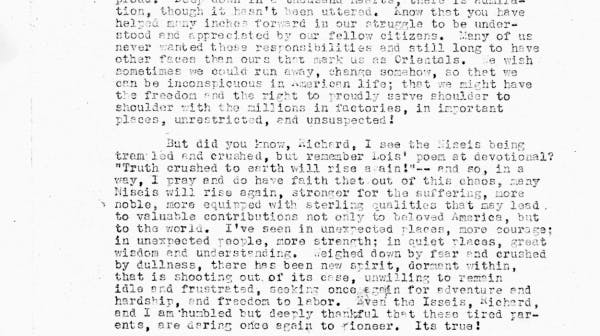
Display Archie Miyatake’s survivor sequence from Seen and Unseen, along with an excerpt from “Letter from Mary Tsukamoto to ‘Richard,’ Soldier in the 442nd Regimental Combat Team.”
Say: A strong explanatory paragraph does more than place two summaries next to each other. It makes a clear point about what readers learn when the sources are read together.
Say: First, I need a claim that applies to both sources, not just one of them. I notice that Archie Miyatake’s survivor sequence shows how incarceration damaged trust because he resented being asked to prove loyalty after his family had been imprisoned. Mary Tsukamoto’s letter adds another perspective by describing what forced removal cost her family in home, work, and stability. That helps me write a first sentence about lasting harm instead of a first sentence about only one person. Next, I choose at least one specific detail from each source, and I attribute each detail clearly. Then I add a sentence that explains the relationship between the two sources so the paragraph sounds like a synthesis, not two separate summaries.
Display the model introductory sentence:
By comparing Archie Miyatake’s survivor sequence in Seen and Unseen with Mary Tsukamoto’s letter, readers can better understand how these sources show that incarceration caused both emotional responses like anger and long-term loss for Japanese American families.
Say: Next, I choose at least one specific detail from each source, and I attribute each detail clearly.
Model writing the evidence sentences:
Seen and Unseen recounts Archie Miyatake’s anger at being asked to prove loyalty to a government that had imprisoned his family. In her letter, Mary Tsukamoto describes how forced removal uprooted her family from Florin and took away the stability they had built before the war.
Say: Then I add a sentence that explains the relationship between the two sources by using a connector such as however, similarly, or together. Finally, I end by returning to the Essential Question and explaining why reading multiple sources leads to a more responsible interpretation.
Model writing the synthesis and conclusion:
Together, these sources show that incarceration caused different kinds of harm, including emotional pain, loss of home, and broken trust. Reading the sources side by side helps us bear witness responsibly because it keeps us from turning families’ experiences into one simple story.
Pulse Check (W.7.2a, W.7.9b) |
|---|
Which sentence best synthesizes information from Seen and Unseen and an external source? A. Seen and Unseen includes a survivor sequence about Archie Miyatake, and my external source is Mary Tsukamoto’s letter.
B. Archie Miyatake felt angry, and Mary Tsukamoto wrote that her family lost their home when they were forcibly removed.
C. Together, Seen and Unseen and Mary Tsukamoto’s letter reveal that incarceration caused both emotional damage and lasting loss because the sources show anger at government actions and the loss of home and stability.
D. Mary Tsukamoto’s letter is better than Seen and Unseen because it gives more information.
|
Display the following writing model if needed for support and guidance:
Overall, the sources show that incarceration caused lasting harm, but people did not all experience that harm in the same way. In the survivor sequence about Archie Miyatake, Seen and Unseen describes his anger at being asked to prove loyalty to a country that had imprisoned his family. In her letter, Mary Tsukamoto explains that forced removal uprooted her family from Florin and took away a home and livelihood they had built over time. Together, these sources indicate that incarceration damaged both trust and stability. Looking at both sources helps us bear witness responsibly because it reminds us that government actions affected families emotionally and materially over many years.
Ask: In your presentation, you’re making choices about which images and testimony to include. Those choices carry weight. What is one thing you want your audience to feel, not just learn, from your presentation? How will you design that experience responsibly?
I want my audience to feel the contrast between the government’s orderly language and the reality of what families experienced. I’ll design that by placing the official memo first so the audience reads it in the government’s neutral tone, and then immediately showing the survivor’s description of what the policy actually meant in reality.
Say these Directions: In your journal, write an explanatory paragraph that synthesizes information from Seen and Unseen and one other source. Start with a claim, include evidence from each source, explain a pattern or difference, and end by connecting your insight to the Essential Question. As you draft, use precise reporting verbs and at least one transition such as overall, together, in contrast, or collectively.
Say: Your paragraph should include these parts:
Claim: What do your chosen sequence and external source reveal about life during incarceration or under the incarceration policy?
Evidence: Cite details from each source, including text or image details from Seen and Unseen.
Analysis/Synthesis: Explain patterns, differences, or omissions and how these affect your understanding.
Connection to the Essential Question: Conclude by explaining how combining sources helps readers interpret historical events responsibly.
After students draft, have them exchange paragraphs with a partner for a quick review using these checkpoints:
Say these Directions: As you read your partner’s paragraph, ask yourself these questions:
Did the paragraph include evidence from both Seen and Unseen and an external source?
Did the writer explain a pattern, difference, or omission?
Did the writer connect the explanation to the Essential Question?
Is the paragraph mostly analysis, not just summary?
Your paragraph clearly uses both sources, and your claim connects to both. Add one more sentence after your second piece of evidence that explains why the difference between the sources matters.
Checklist (W.7.2.a, W.7.2.b, W.7.2.d, W.7.2.f) |
|---|
As you write your explanatory paragraph, make sure you:
|
Quick Write | Domain: Writing | Action: Write-on Lines (Small)
Say these Directions: In two or three sentences, name one pattern, difference, or insight you noticed when you combined your external source with Seen and Unseen. Then explain how today’s paragraph can help you move forward on your presentation.
Ask: How did today’s work deepen your understanding of the experiences of incarcerated Japanese Americans?
I noticed that my external source included uncertainty that was not as obvious in the book. The speaker could not remember some basic details from childhood, which helped me understand how confusing and overwhelming forced removal was for young children. This insight will help my presentation because I want to show that memory can be incomplete and still be important evidence.
Say: Before we close, look back at your paragraph and underline one sentence you may want to reuse or adapt in your final presentation. Today’s writing makes future presentation work easier because it gives you a clear claim and evidence you can build on.
Teacher Tip |
|---|
If time remains after the Look Back activity, have students underline or circle ideas in their paragraphs that they may want to use in their presentations. These do not have to become word-for-word script lines; they could become themes, quotations, image captions, or talking points. |
Instruct students to complete the following:
Review your paragraph in your Journal. Underline one sentence you want to keep for your presentation, and add one note about a quotation, image, or detail you may still need.
Seen and Unseen
Elizabeth Partridge & Lauren Tamaki

Letter from Mary Tsukamoto to “Richard,” Soldier in the 442nd Regimental Combat Team, October 21, 1943
California State University