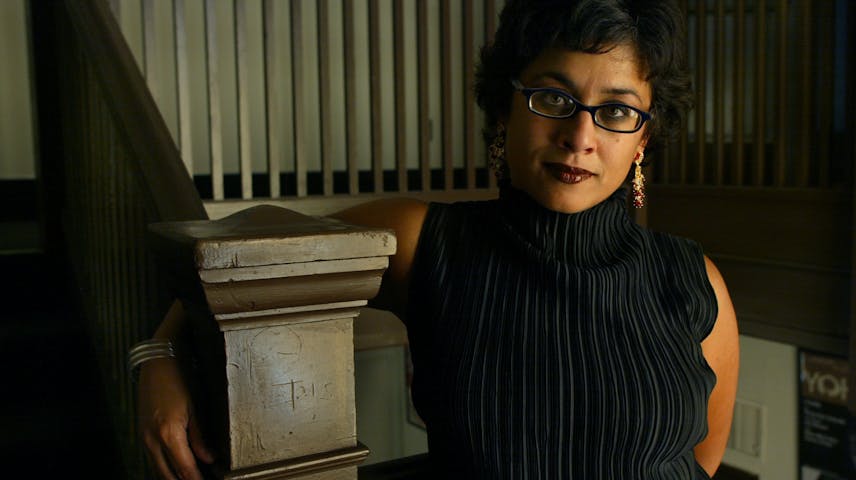
Sujata G. Bhatt is an award-winning Indian playwright and poet. Bhatt was photographed at the East West Players Theater in Los Angeles, California in 2002. Photo by Anacleto Rapping/Los Angeles Times via Getty Images
By
Sujata Bhatt
Text Type
Poem
Words
212
Published
1988
You ask me what I mean
by saying I have lost my tongue.
I ask you, what would you do
if you had two tongues in your mouth,
and lost the first one,
the mother tongue,
and could not really know the other,
the foreign tongue.
You could not use them both together
even if you thought that way.
And if you lived in a place you had to
speak a foreign tongue,
your mother tongue would rot,
rot and die in your mouth
until you had to spit it out.
I thought I spit it out
but overnight while I dream,
munay hutoo kay aakhee jeebh aakhee bhasha
may thoonky nakhi chay
parantoo rattray svupnama mari bhasha pachi aavay chay
foolnee jaim mari bhasha nmari jeebh
modhama kheelay chay
fullnee jaim mari bhasha mari jeebh
modhama pakay chay
it grows back, a stump of a shoot
grows longer, grows moist, grows strong veins,
it ties the other tongue in knots,
the bud opens, the bud opens in my mouth,
it pushes the other tongue aside.
Everytime I think I’ve forgotten,
I think I’ve lost the mother tongue,
it blossoms out of my mouth.
Credit: Sujata Bhatt. “Search for My Tongue” from 'Brunizem.' Carcanet Press, 1988. Used by permission of the publisher.
Have students take out their drafts from Lesson 17 and place a finger on their claim before speaking.
Turn-and-Talk
Say these Directions: In Lesson 17, you wrote a full argument in response to the question: Is symbolism an effective way for a writer to express the experience of living between two cultures? You took a position, selected evidence from Bhatt and LaRocca, and explained how that evidence relates to your claim. Today we are returning to those drafts to check whether your argument holds together from beginning to end.
A claim is a commitment to your reader. It isn’t enough to state it once in your introduction; every paragraph that follows has to keep honoring it. When a claim fades, the writing drifts into summary: retelling what happens in the poem instead of arguing what it means.
Partner A speaks for 30 seconds, then Partner B speaks for 30 seconds.
Ask: Where in your draft does your claim feel most alive right now? Where can you actually feel the argument working, and where does it start to fade into description or summary?
My claim feels strongest in my introduction because I clearly state that symbolism reveals something about living between two cultures that a direct statement would miss. It probably needs more work in my second body paragraph—I introduced the water imagery from “Two” and quoted it, but I moved on without fully connecting it back to my argument about why symbolism is effective.
Connection to Today’s Learning:
Students have named where their essays are strongest and where the argument needs more support or clarity, so they are ready to learn one concrete revision move before reading a partner’s draft.
Guide students in strengthening body paragraphs by keeping the claim visible through precise analysis. Support students in revising vague statements into clear sentences that name the symbol, use a strong verb, and explain its significance.
Language Study
Say these Directions: Today’s revision move is simple: do not let the claim disappear after the introduction. Remember, strong body paragraphs:
Name the symbol
Use a precise verb
Explain what idea the symbol reveals.
We are going to study one weak sentence and one stronger revision so we can see exactly how that move works.
Display page 1 of Red, White, and Whole by LaRocca and direct students to read this excerpt:
Target Sentence:
“I swim in a river of white skin / I float in a sea of brown skin and black hair and dark eyes.” (p. 1)
Display the following weak analysis sentence and revised sentence:
Weak sentence: This image shows Reha is different.
Revised sentence: LaRocca crafts the river and sea as symbols for Reha’s two cultural worlds, making her bicultural identity feel less like a choice between two places and more like two currents she is always moving between.
Chunk
Meaning
Function
LaRocca crafts the river and sea as symbols for Reha’s two cultural worlds,
The poet changes physical details into symbolic images.
keeps the claim focused on symbolism
making her bicultural identity feel less like a choice between two places and more like two currents she is always moving between.
The symbol feels active, split, and difficult to hold together.
explains why the symbol matters
Teach: Revision Move: Keep the Claim Visible
Say: When I read the weak sentence, I notice it isn’t exactly wrong, but it’s too vague to carry an argument. Saying Reha is “different” doesn’t remind the reader what the essay is actually claiming about symbolism.
First, I notice that in the revised sentence, I name the symbols directly:river and sea.
Then, I use a precise verb: crafts, to show that this is a deliberate authorial choice.
Next, I add a clause that explains what those symbols do to the idea of bicultural identity.
Say: That explanation is what keeps the claim visible instead of letting the paragraph drift into summary.
Say: As you revise, check that each body paragraph has at least one sentence that does all three things: names the symbol, describes the author’s choice, and explains the significance or effect of that choice.
🎯PURPOSE
Support students in expanding vague commentary into precise analytical sentences that connect evidence to a claim.
Language Focus:
precise analytical verbs
relative clauses with which
symbolism commentary language
🗣️SAY / ASK
Display and briefly contrast vague verbs like shows or is with stronger verbs like turns, reveals, conveys, and intensifies.
Invite students to orally rehearse one revision before they write so they can hear whether the claim is still visible.
You said “The image is about being stuck.” We can say: “The symbol conveys Reha’s feeling of being pulled between cultures.”
You said “The author says it in a stronger way.” We can say: “The poet intensifies the claim by turning a physical detail into a symbol.”
The symbol of __________ reveals __________.
The poet turns __________ into a symbol of __________.
This wording strengthens the claim because it explains __________.
Allow students to compare how they would explain the same symbol in everyday speech and then shift that idea into academic language.
👁️WATCH FOR / SUPPORT IF NEEDED
If students revise by only adding more adjectives → Prompt: “What is the symbol doing in the argument? Name the idea it reveals.”
If students restate the quote without commentary → Prompt: “Finish this sentence: ‘This symbol matters because _________.’”
Student names the symbol directly in their revised sentence.
Student adds commentary that explains significance, not just repeated wording from the quotation.
Check for Understanding (W.7.5)
Revise this sentence so the claim about symbolism is visible:
This image is important because Reha is different.
Modeling:
If students need support, prompt them to name the symbol first, choose a precise verb like reveals, turns, or conveys, and then explain the idea the symbol communicates.
Connection to Today’s Learning:
Students now have one clear revision move to carry into partner feedback and independent revision.
Situation
Try this
Struggling with
turning summary into commentary: Give students a sentence frame with blanks: The symbol of __________ reveals __________ because __________. generating precise verbs: Display a short verb bank for revision: reveals, conveys, intensifies, turns, symbolizes, emphasizes.
Ready for extension
Revise two sentences from the draft instead of one and explain which revision is stronger. Challenge students to combine evidence and commentary into one sentence without losing clarity.
Learning in Action Part A: Trace the Claim (W.7.5)
Pair students with a partner who can read their draft independently. Students should keep the lens narrow: only read for claim visibility, not for every possible issue.
Collaborative Revision Protocol
Say these Directions: Trade drafts with your partner. Read your partner’s essay for one thing only:
Does the claim about symbolism stay visible from the introduction through the body paragraphs and conclusion? OR
Does it disappear or fade in some spots?
As you read, underline one sentence where the claim is clear, put a star beside one place where it fades, and write one specific note before returning the draft.
Use the following feedback stems as you discuss and revise with your partner:
Your claim stays visible when you __________.
The claim fades in paragraph __________ because __________.
A strong next revision would be to __________.
🎯PURPOSE
Support students in giving specific, usable feedback that names where an argument is clear and where revision is needed.
Language Focus:
feedback language
paragraph-specific references
cause-effect language for revision suggestions
🗣️SAY / ASK
Remind students that helpful feedback names a location in the draft and a reason, not just praise.
Prompt students to use paragraph references or text landmarks from the essay instead of vague phrases like this part.
You said “It gets confusing here.” We can say: “In the second body paragraph, the claim fades because the symbol is no longer named.”
You said “Add more explanation.” We can say: “Add commentary explaining how the growing tongue symbolizes identity returning.”
In the __________ paragraph, your claim is clear because __________.
The argument weakens when the draft starts to summarize __________ instead of analyzing __________.
One revision that would strengthen the symbolism claim is __________.
Allow partners to verbally explain their feedback before writing it so ideas can be clarified in the language most accessible to them first.
Formative s-Fors:
Student writes one note that names a specific paragraph or sentence.
Student focuses feedback on claim visibility rather than unrelated conventions.
👁️WATCH FOR / SUPPORT IF NEEDED
If students give praise only → Prompt: “What exact sentence helped the claim stay visible?”
If students mark too many issues at once → Prompt: “Stay with one lens. We are not editing everything yet; we are tracing the claim.”
Pulse Check (W.7.5)
Which feedback note would help a writer most if the goal is to keep the claim about symbolism visible throughout the essay?
A. Add more details in the middle.
Incorrect: This feedback is too vague because it does not identify where the problem is or how symbolism should stay visible.
B. I liked your essay because it was interesting.
Incorrect: This is encouraging, but it does not provide a revision move the writer can use.
C. In your second body paragraph, you summarize the event, but you stop explaining the role of the symbol. Add a sentence explaining how the growing tongue symbolizes identity returning.
Correct: This feedback is specific, paragraph-based, and directly explains how to revise for claim visibility.
D. Put a better hook in the introduction.
Incorrect: This advice focuses on the opening only and misses the lesson’s revision target across the whole essay.
Situation
Try this
Struggling with
writing specific partner feedback: Give them a frame to complete: In paragraph ___, your claim is clear/fades because ___. reading a partner’s draft fluently enough to respond: Allow the writer to read one paragraph aloud while the partner follows and notes where the claim is visible.
Ready for extension
Have students identify not only where the claim fades, but which exact revision move would fix it: stronger verb, clearer commentary, or better evidence integration. Invite students to compare the visibility of the claim in the introduction and conclusion and suggest a way to tighten both.
Learning in Action Part B: Revise, Edit, Submit (W.7.5)
Use an example sentence modeled aloud before students return to their own drafts.
Revision Sprint
Display the following weak sentence and revision:
Weak sentence: In “Search for My Tongue,” the speaker says her tongue grows back, and that means she remembers her language.
Stronger revision: Bhatt turns the tongue into a living plant, so the image symbolizes language and identity growing back even after loss.
Teach: Strengthen the Sentence So the Argument Lands
Say: I want to show you one revision move that makes an argument hit harder. The weak sentence mostly retells what happens, but it does not sound like an essay about symbolism. In the stronger version, I start with a more precise verb: turns, because that shows the poet is making an intentional craft choice.
I also replace the vague phrase, that means, with the more exact word: symbolizes.
Then I use the phrase: language and identity growing back even after loss so the sentence carries both evidence and commentary instead of stopping at summary.
Say: When you revise today, look for one sentence that only tells what happens and turn it into a sentence that explains what the symbol does in your argument.
Display the following writing model if needed for support and guidance:
One reason symbolism is especially effective in “Two” is that LaRocca makes Reha’s identity feel physical instead of abstract. When Reha says she “swim[s] in a river of white skin” (p. 1) and “float[s] in a sea of brown skin and black hair” (p. 1), the river and sea symbolize the two cultural worlds surrounding her. These are not just descriptions of bodies. The water imagery conveys motion and pressure, which helps readers feel how Reha is constantly carried between identities instead of fully settled in one. Because the symbol stays connected to the idea of bicultural identity, the paragraph keeps the essay’s claim visible from start to finish.
Say these Directions: Revise your argumentative essay in response to the feedback you received from your partner. First, revise at least one body paragraph so the claim about symbolism stays visible through stronger wording or sentence structure. Then edit your full draft using the following checklist:
Display this editing checklist:
I can find my claim about symbolism in every paragraph.
I named the symbol or image directly instead of saying this or it too often.
I introduced evidence by explaining what was happening in the text, not just giving a title.
I revised at least one sentence so that evidence and commentary work together more clearly.
I replaced vague words with precise words like symbolizes, reveals, conveys, intensifies, or regrowth.
I checked grammar and syntax for complete sentences, clear pronouns, and smooth sentence flow.
I checked capitalization, punctuation, and spelling of unit words such as symbolism, identity, bicultural, and commentary.
🎯PURPOSE
Support students in revising and editing their own writing so analytical meaning is clear, precise, and grammatically controlled.
Language Focus:
precise academic verbs
sentence combining for clarity
editing language
🗣️SAY / ASK
Confer first with students whose drafts still summarize more than they analyze; have them revise one key sentence before moving to full editing.
Prompt students to read a revised sentence aloud softly to themselves to hear whether the claim is still visible and the syntax is clear.
You said “I want it to sound smarter.” We can say: “I want my commentary to sound more precise and analytical.”
You said “This part doesn’t connect.” We can say: “This evidence needs a clearer sentence linking the symbol back to the claim.”
I revised this sentence by changing __________ to __________ so the claim is clearer.
This symbol supports my argument because __________.
I edited this paragraph for clarity by __________.
Allow students to orally rehearse a revised sentence before writing it, including in a shared home language if that helps them clarify the idea first.
Encourage students to draw on familiar language about identity and belonging from prior lessons, then translate their ideas into formal analysis.
👁️WATCH FOR / SUPPORT IF NEEDED
If students keep replacing words without improving meaning → Prompt: “What idea about identity, loss, or regrowth should the reader understand more clearly after this sentence?”
If students make sentences longer but less clear → Prompt: “Split the sentence, then rebuild it with one clear claim connection.”
Student revises at least one sentence from summary to commentary.
Student edits for clarity and correctness without losing the meaning of the analytical claim.
Writing prompt: Revise your literary analysis essay so that the claim about symbolism or imagery remains clear and visible throughout all body paragraphs. Strengthen vague commentary, sharpen evidence connections, and edit for clarity and correctness.
Criteria
1 — Beginning
2 — Developing
3 — Proficient
Thesis & Claim Visibility
(W.7.2.a)
Claim Stays Visible Throughout
Revision does not address claim visibility. The claim is still unclear or disappears after the introduction.
The thesis is revised to be clearer, but body paragraphs still lose track of the claim. Not all evidence is connected back to the central argument about imagery or symbolism.
Revision ensures the claim about how a specific image or symbol reveals something meaningful stays visible in every body paragraph. Each paragraph connects its evidence back to the thesis through precise commentary.
Evidence & Commentary
(W.7.2.b)
Strengthen Evidence Connections
Vague or paraphrasing commentary remains unchanged in the revision. Evidence is still dropped in without explanation.
Some commentary is strengthened in revision, but not consistently. One or two paragraphs still paraphrase evidence rather than explaining what the image or symbol reveals.
Revision strengthens commentary throughout the essay. Each piece of evidence is introduced with a signal phrase and followed by commentary that explains what the imagery or symbolism reveals — not just what the line says.
Teacher Feedback Look-Fors
Activity: Revision Sprint
Instruction: Circulate and provide real-time feedback on student drafts based on the following observable language behaviors:
- Target 1 (The Strategy): Students revise using the partner note rather than starting over or making random edits.
- Target 2 (Claim Visibility): Students keep the claim about symbolism visible in body paragraphs by naming the symbol and explaining its meaning.
- Target 3 (Navigation): Students introduce evidence by connecting to specific parts in the text instead of dropping a quotation with no context.
- Target 4 (Precision and Syntax): Students replace vague wording with precise academic verbs and edit sentences for clarity and grammatical control.
Say: As you revise, check your work for these three things:
Did I keep my claim visible?
Did I explain what the symbols mean?
Did I edit at least one sentence for stronger wording and clearer syntax?
Provide students with a confidence continuum (i.e., 1–5). As needed, model how to demonstrate a level of confidence using the continuum.
Reflection (W.7.5)
Use the Reflection routine to reflect on your ability to revise your writing so your claim is clear, your evidence is explained, and your sentences are precise and well-structured.
Situation
Try this
Struggling with
Getting to a complete final draft: Confer with the student to set a minimum finish line: complete conclusion, one revised body paragraph, and a final edit pass. Revising in writing: Allow students to orally explain the revision they want to make first, then use speech-to-text or an oral recording to capture the sentence before copying it into the draft. editing for syntax: Have students read one paragraph aloud sentence-by-sentence and pause after each period to check for complete thoughts and pronoun clarity.
Ready for extension
Ask students to revise their conclusion so it echoes the claim with more precise symbolism language. Invite students to identify one sentence that is grammatically correct but still weak, then revise it for stronger rhythm and emphasis.
Have students reflect on specific revisions and edits they made to their draft.
Quick Write
Say these Directions: Before you turn in your work, take one minute to look back over your draft.
Ask: What are two specific changes you made today, and how did each one strengthen your argument? Include:
one revision that improves your claim about symbolism
one revision that improves grammar, syntax, or word choice
Optional Sentence Starter:
One revision that made my symbolism argument stronger was __________ because __________.
One change I made was in my second body paragraph. At first, I wrote, “This image shows the speaker remembers her language,” but I revised it to: “Bhatt turns the tongue into a growing plant, so the image symbolizes language and identity returning after loss.” This change made my claim about symbolism visible again instead of sounding like a summary. My second change was editing a run-on sentence in my conclusion, so the idea was easier to follow.
Instruct students to reread their final essay and respond to the following prompt in their Journals:
What is the one part of your argument you feel least confident about? Explain your reasoning.