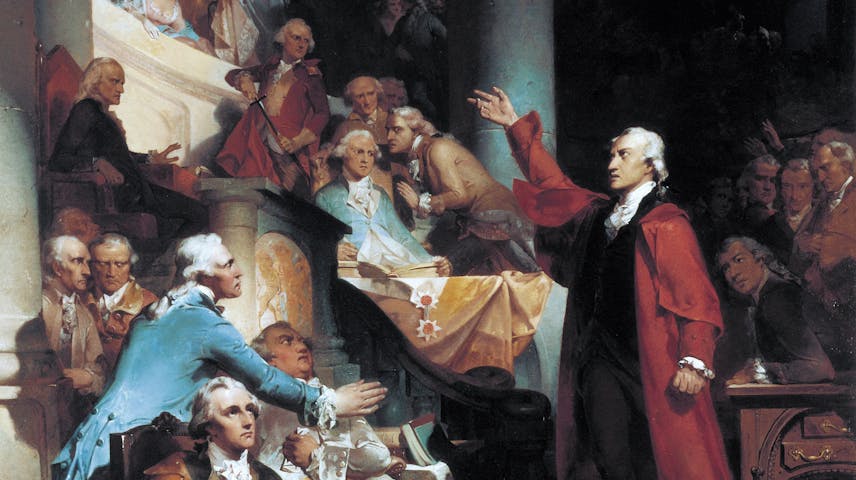
Painting of Patrick Henry's "If this be treason, make the most of it!" speech against the Stamp Act of 1765. Photo by: Painted by Peter F. Rothermel, Public Domain
By
USHistory.org
Text Type
Informational Text
Words
608
Lexile
1160L
Published
05/01/2026
"No taxation without representation!"
"These are the times that try men's souls."
"Give me liberty or give me death!"
All are famous phrases that sparked the American Revolution. In the view of many colonists, British rule suppressed political, economic, and religious freedoms. Many of those that hesitated to support independence were soon convinced by the passionate words of Thomas Paine, Samuel Adams, Patrick Henry, and eventually John Adams and Thomas Jefferson. The Declaration of Independence in 1776, the American Revolution, and the creation of the Articles of Confederation represent the American colonies' first attempt to become a nation. This incubation was tentative at best, but ultimately led to success.
The Declaration of Independence
As tensions between Britain and the American colonies increased, a series of meetings were called, including that of the Second Continental Congress (1775-1776.) On July 4, 1776, the delegates approved the Declaration of Independence, the event that marks the birth of the United States. Thomas Jefferson, a delegate from Virginia, drafted the document primarily as a list of grievances against the king. His most important words, however, clearly shaped the philosophical basis of the new government. The famous introduction clearly reflected John Locke's social contract theory: "...to secure these rights [Life, Liberty, and the pursuit of happiness], Governments are instituted among men, deriving their just powers from the consent of the governed." Jefferson further reasoned that since the British government had abused these rights, the colonists had the right "to alter or to abolish it, and to institute new Government."
The American Revolution and the Articles of Confederation
The British, of course, did not recognize the Declaration and continued to send troops to contain the rebellion. The war continued until 1783, so the new government had to be put in place in a wartime atmosphere. The Articles of Confederation, a compact among the thirteen original states, was written in 1776 but not ratified by the states until 1781. The loose "league of friendship" that it created reflected the founders' reaction to the central authority of King George III.
The government gave most powers to the states, and the central government consisted only of a legislature. Above all, the colonists wanted to preserve their liberties, but the central governments' lack of power proved to be disastrous. It could not regulate trade or keep the states from circulating their own currency. No chief executive could make real decisions, and no national court could settle disputes among states. And perhaps most importantly, they could not efficiently conduct a war nor pay the debts incurred once the war was over.
By 1786 the new country was in serious economic straits, and states were quarreling over boundary lines and tariffs. An economic depression left not only states in trouble, but also many ordinary citizens, such as farmers and merchants, were deep in debt as well. Shays' Rebellion, a revolt by angry farmers in Massachusetts, symbolized the chaos in the country. Even though the Massachusetts militia finally put the rebellion down, it pointed out the inability of the central government to maintain law and order. In reaction, Alexander Hamilton of New York initiated the organization of a meeting in Philadelphia in 1787. This convention would eventually throw out the Articles of Confederation and draft the Constitution.
So the freedom that the American Revolution sought to preserve proved to create a government under the Articles of Confederation that could not keep law and order. But the failure of the initial experiment helped the founders to find a more perfect balance between liberty and order in the Constitution they produced in 1787.
Credit: Copyright Independence Hall Association. Used with permission of the publisher.
Students engage in a partner discussion to discuss why revolutions either uphold or betray their original ideals.
Think-Pair-Share
Transition students into pairs to engage in a Think-Pair-Share activity about revolutionary ideals.
Say these Directions: Discuss the following questions with your partner:
Why are some revolutions able to protect their ideals?
Revolutions protect their ideals when leaders remain accountable to the people and continue to follow the original principles of the revolution.
Why do some revolutions betray their original ideals?
Greed, corruption, or a desire to gain and maintain power can cause leaders to abandon the original ideals of a revolution.
After pairs finish discussing, invite one to two students to briefly share what they discussed with the class.
Connection to Today’s Learning
Say: You now have evidence of how historical and fictional revolutions progress and what influences whether or not the original ideals are protected or corrupted. Today, your task is to use that evidence to build a precise, arguable claim for your unit performance task. Strong revolutions rise on strong ideas, and strong essays rise on strong claims.
Mini-Lesson: What makes a Powerful Claim When Writing an Argument?
Explain that you will be discussing argument claims and how to identify a strong claim. Remind students that they have previously discussed argument claims in Lessons 14 and 22, and this lesson will build on that work.
Display the performance task prompt: Write an argument essay explaining how Animal Farm shows that revolutions can either protect or corrupt ideals.
Say: When we come to the performance task for the unit, you will be making a claim in response to this prompt. A claim is a position or stance you are taking on a topic. It is your opinion based on evidence. In argument writing, your claim is the position you are arguing for.
Display the example claims below for the class.
Say: These are examples of weak claims. They do express an opinion, but these opinions are not fully thought out. The claims are vague and not specific enough to the argument we want to make.
“Some revolutions fail because of bad leaders.”
“Animal Farm shows that revolutions can go wrong.”
“Propaganda affects revolutions.”
Say: Here are some stronger claims that are more specific and answer the prompt more directly.
“Revolutions fail when leaders use fear instead of upholding the revolution’s ideals.”
“Napoleon’s dictatorship shows how the Animal Farm revolution betrayed its original goals.”
Display the following Checklist for a Strong Argument Claim.
Say: Our argument claims need four components:
Answers the prompt by taking a position
Names specific forces or conditions that played a part in the revolution
Clearly shows the cause and effect in the revolutions’ outcomes
Is arguable, meaning someone could disagree
Say: Here is a strong claim that we can look at as an example:
“Animal Farm shows that revolutions are corrupted when the leaders take control of education and the laws, which causes the other animals to lose their agency and eventually their freedom.”
Allow one to two students to communicate ideas for strong claims as time allows.
🎯PURPOSE
Purpose: Help students distinguish weak vs. strong claims by naming one causal force, previewing evidence, and using academic connectors to make the claim arguable and precise.
Validate multiple defensible stances (ideals corrupted, preserved, or both) as long as students make the claim precise and evidence-ready.
🗣️SAY / ASK
Require claims to include one clear “because” reason that names a force (fear, propaganda, control of truth, lack of accountability).
Require one academic connector that signals causation (therefore, as a result, which leads to).
“A strong claim is arguable because someone could say ___ instead.”
“Animal Farm suggests ___ because ___; similarly, the Russian/American Revolution shows ___.”
“As a result, the ideal of ___ is protected/betrayed.”
👁️WATCH FOR / SUPPORT IF NEEDED
Revoice vague claims: “Revolutions go wrong” → “Revolutions betray ideals when ___, which leads to ___.”
Tighten scope: “Many things” → “One main force is ___.”
Upgrade word choice: bad → corrupted; changed → eroded/revised; lies → distorts/manipulates.
If claim lists multiple unrelated reasons → Prompt: “Choose one main force and cut the rest.”
If claim is plot summary → Prompt: “Name the ideal + the force + the effect on people’s beliefs/actions.”
If claim lacks cross-text preview → Prompt: “Add: ‘This is also seen in ___ (historical text) when ___.’”
Claim answers the prompt and is arguable.
Claim names one causal force and one betrayed/protected ideal.
Connection to Today’s Learning
Say: Today, we will be working on developing strong claims in response to the performance task prompt.
Part A: Developing an Argument Claim (W.8.1.a) (15 minutes)
Explain that students will now begin developing a strong claim for their final argument essay by connecting ideas from Animal Farm with historical examples studied in the unit.
Say: Before writing a claim, strong writers first organize their ideas and evidence to make sure their claim can be supported by evidence. Answer the questions below to begin developing your claim for the unit performance task.
Turn and Talk
Transition students into pairs. Have students develop their claims using the following steps by talking about each step with a partner.
Step 1: Identify the main explanation
Say these Directions: What is your main explanation for why revolutions uphold or betray their ideals based on Animal Farm and the other historical events explored in the unit?
Instruct students to talk with their partner about the main explanation. Encourage students to choose one main explanation, not several unrelated ideas.
fear, control of information, propaganda, erasure of truth, lack of accountability, corrupted leadership
Step 2: Evidence from Animal Farm
Say these Directions: What is evidence from Animal Farm that supports your main explanation? Which moments in the text best support your position?
Instruct students to talk with their partner about evidence from Animal Farm that supports their main explanation or position.
Throughout the novel, Napoleon uses violence and fear to control the animals. For example, in Chapter V, Napoleon uses the dogs to chase Snowball off the farm, showing how violence replaces democratic debate and allows Napoleon to take control.
Step 3: Evidence from the Russian Revolution
Say these Directions: What is evidence from the Russian Revolution that supports your main explanation? Which detail best supports your position?
Instruct students to talk with their partner about evidence from the Russian Revolution that supports their main explanation.
During the Russian Revolution, political opponents were intimidated, arrested, or even executed. This shows how fear and violence were used to silence opposition and maintain power. In Chapter VII of Animal Farm, Napoleon orders the animals to confess and then has them executed. This moment mirrors how revolutionary leaders may use fear and violence to silence opposition and maintain control.
Step 4: Evidence from the American Revolution
Say these Directions: What is one contrasting or reinforcing example from the American Revolution? How does it show a different outcome OR a protected ideal?
Instruct students to talk with their partner about evidence from the American Revolution that either supports or negates their main explanation.
After the American Revolution, leaders created the Bill of Rights to protect freedoms such as speech and religion. This shows how a revolution can protect its ideals by limiting government power and protecting citizens’ rights. In Animal Farm, the pigs secretly change the Seven Commandments, removing protections for equality. Unlike the American Revolution’s attempt to protect rights through written laws, the pigs manipulate the rules to increase their power.
Step 5: Propaganda or rhetorical techniques in Animal Farm
Say these Directions: What is one example of propaganda or rhetorical techniques from Animal Farm that supports your position? What does it reveal about how leaders influence belief or action?
Instruct students to talk with their partner about propaganda or rhetorical techniques from Animal Farm that support their position.
Squealer tells the animals that the pigs need milk and apples because they are the “brainworkers,” convincing them that the pigs deserve special privileges (p. 36). This propaganda persuades the animals to begin to accept inequality on the farm.
Transition students into working independently to draft their claim based on the preceding steps and their partner discussion.
Step 6: Draft your claim
Say these Directions: Now combine your ideas into a clear, arguable claim. Use the following frame to begin drafting:
Display the following frame to support students in drafting their claim.
Revolutions uphold or betray their ideals when __________, as shown by __________ in Animal Farm, __________ in the Russian Revolution, and through __________ persuasion or rhetorical techniques.
Encourage students to revise the frame as needed to make their claim clear and precise.
Circulate to check for accuracy and conceptual clarity as students draft their claims.
🎯PURPOSE
Support students in building a precise, arguable claim from evidence by selecting the strongest cross-text examples and organizing them into a logical cause-and-effect claim frame.
🗣️SAY / ASK
Encourage students to use the evidence they already understand best; precision beats breadth.
Consider aligning the labels with the organizer structure: “Animal Farm evidence,” “Russian Revolution evidence,” “American Revolution evidence,” and “propaganda/rhetorical technique.”
Require students to state how each example supports the same force (not a new force each time). Encourage students to rehearse using causal connectors such as because, therefore, or which leads to.
Require a quick verbal rehearsal of the claim using a frame before writing.
Press for alignment: “Does this evidence prove your force or a different one?”
“My main force is ___; in Animal Farm, ___ shows this because ___.”
“In the Russian Revolution, ___ mirrors/contrasts this because ___.”
“Therefore, revolutions ___ their ideals when ___.”
👁️WATCH FOR / SUPPORT IF NEEDED
If student picks weak evidence → Prompt: “Choose a moment with clear consequences (fear, executions, commandment changes, propaganda speeches).”
If student can’t connect history → Prompt: “Use one organizer detail: leadership change, institutions, suppression, rights protections.”
Student selects at least one Animal Farm moment + one historical detail that match the same force.
Student explains the connection with because/therefore/as a result.
Student keeps the claim focused on one main explanation.
Teacher Tip
When students draft their claims, it may be helpful to remind them that Orwell wrote Animal Farm as an allegory, meaning that shifts in the pigs’ language and behavior mirror shifts in historical power. If students identify a changed commandment, encourage them to connect it to a similar change after the Russian Revolution. This helps students move away from simply describing the plot and toward analyzing how power operates in both fiction and history.
Situation
Try this
Struggling with: Abstract ideals
Students may struggle with abstract ideals. Provide a word bank for students to draw on as they write. Ex. power, memory, fear, equality, deception, subjugation, hope, freedom
Struggling with: Comparing fact and fiction
Have students prepare a side-by-side comparison chart by finding events from the Russian Revolution that match themes or outcomes. Ex. The Bolsheviks used propaganda to influence people. The pigs used propaganda to influence people.
Ready for extension: The power of language
Ask: Why is it more effective for Napoleon to change the Seven Commandments slowly over several years rather than changing them all at once?
If Napoleon changed them all at once, the animals would immediately notice that the revolution was failing and might resist or question the pigs’ authority. By changing them slowly over time, the animals are more easily manipulated because they do not necessarily trust themselves to remember what came before.
Provide students with a confidence continuum (i.e., 1–5). As needed, model how to demonstrate a level of confidence using the continuum.
Reflection
Reflect on your understanding of how to write a strong claim in argument writing using the Reflection routine.
How confident are you in writing a strong claim for your argument?
Part B: Introducing the Claim (W.8.1.a, W.8.4, W.8.5) (15 minutes)
Introducing the Claim
Instruct students to develop their claim in an introductory paragraph (three to five sentences) using the following criteria. Display the following information and review it with students.
Develop an introductory claim paragraph (three to five sentences), including:
A brief introduction to the topic and the text, Animal Farm
Your argument’s claim
A brief preview of the evidence you will use in the final essay
Say: Use your claim-building from the first half of the lesson and the example frame below to draft your introductory claim paragraph. Your paragraph should clearly explain why revolutions protect or betray their ideals and preview the examples you will use as evidence.
Display the following example frame to support students with writing this introductory paragraph.
Example Frame:
“Throughout history and in Animal Farm, revolutions rise with hope but collapse when ________. This pattern appears in Orwell’s depiction of ________, the Russian Revolution’s ________, and propaganda messages that rely on ________. Together, these examples show that revolutions often betray their ideals because ________.”
Provide students with time to independently draft their introductory claim paragraphs.
Peer Review Protocol
Have partners exchange claim paragraphs.
Say these Directions: Use this checklist to review your partner’s introductory claim paragraph.
Display the checklist.
Checklist: A strong argument claim must:
Identify one main explanation (not several unrelated ideas)
Distinguish itself from other claims
Include a reference to Animal Farm
Be arguable and precise (not a summary)
Have partners offer one suggestion to strengthen precision (word choice, clarity, or specificity). Allow students to revise their claim paragraphs based on feedback.
Writing prompt: Draft a clear introductory paragraph for your argument essay that develops a precise, arguable claim explaining how Animal Farm demonstrates that revolutions can protect or corrupt ideals (or both).
Criteria
1 — Beginning
2 — Developing
3 — Proficient
Claim & Argument
(W.8.1.a)
Precise Claim + Preview
The introduction does not include a clear claim, or the claim does not address how revolutions in Animal Farm protect or corrupt ideals. No preview of the argument is offered.
The introduction includes a claim about the revolution in Animal Farm, but it is vague or does not fully set up the argument. The preview of main points is absent or unclear.
The introduction presents a precise, arguable claim that explains how Animal Farm demonstrates that revolutions can protect or corrupt ideals. The claim previews the argument clearly and invites the reader into the essay.
🎯PURPOSE
Help students draft and revise a three-to-five-sentence claim paragraph that previews evidence and uses academic register and causal connectors.
🗣️SAY / ASK
Encourage students to keep the paragraph “essay-ready” by using formal tone, precise terms, and no plot retelling beyond what supports the claim.
Require students to include at least two academic connectors (however, therefore, as a result, whereas) to show relationships between ideas.
Require students to revise one word or phrase for precision after peer feedback (e.g., replace a vague word with a more specific verb or noun).
Replace “shows” with analytical verbs: illustrates, reveals, demonstrates, suggests.
Clarify causal reasoning: replace simple “because” with more precise connectors such as “which leads to,” “therefore,” or “as a result.”
“Throughout ___, revolutions ___; however, they ___ when ___.”
“This pattern appears in Animal Farm when ___ and in ___ when ___.”
“Therefore, the revolution’s ideal of ___ is ___.”
👁️WATCH FOR / SUPPORT IF NEEDED
Require a three-part structure: context → claim → evidence preview.
Replace vague nouns: things → conditions; people → citizens/leaders; problems → betrayals/contradictions.
If paragraph includes multiple claims → Prompt: “Underline your claim sentence. Delete any sentence that introduces a new force.”
If paragraph lacks an evidence preview → Prompt: “Add one phrase naming your evidence types: commandment changes, propaganda speeches, historical policy/outcome.”
The revised version is more specific than the first draft.
Situation
Try this
Struggling with: Digging deeper
Have students underline the word “because” in their claim. If what follows is just a plot point, have them ask, “So what does this show about the revolution’s ideals?” Students should then revise the sentence to explain the larger idea or principle, not just the event. Ex. "because the pigs moved into the house" → “because the pigs prioritized personal privilege over communal equality."
Struggling with: Reviewing for precise language
Provide a small table of vague words and precise alternatives. During peer review, partners should identify vague language and suggest a stronger revision. Encourage students to replace general language with precise academic vocabulary that explains how ideals are protected or betrayed.
Ready for extension: Importance of knowledge
Ask: In Animal Farm and the Russian Revolution, the leaders were often more educated than the workers. How does a “gap in knowledge” make it easier for a revolution to be betrayed? When only one group understands laws, information, or language, it becomes easier for them to manipulate others. In Animal Farm, the pigs can read and write, which allows them to secretly change the commandments and control what the other animals believe.
Vague word
More precise alternatives
bad
corrupted, unjust, abusive
changed
distorted, revised, eroded
lied
manipulated, misled
scared
intimidated, threatened
Check for Understanding
Your finished claim paragraph should include an answer to the prompt that:
Takes a position
Names specific forces or conditions (e.g., propaganda, fear, control of information)
Clearly shows the cause and effect in the revolutions’ outcomes
Is arguable, meaning another interpretation could reasonably disagree
Turn and Talk
Prepare students to reflect on the following prompt with a partner:
Say these Directions: Turn to your partner and discuss the following questions:
How did writing your claim today help you better understand why revolutions rise or betray their ideals? Use an example from Animal Farm or from the historical events we discussed in class.
Writing my claim helped me understand that revolutions often fail when leaders control information. In Animal Farm, Napoleon changes the Seven Commandments, and Squealer uses speeches to convince the animals that the pigs are always right.
Invite one to two students to briefly share their thinking with the class.
Instruct students to read Chapter IX of Animal Farm. Instruct students to take notes in their Journal on the following prompt: How does Chapter IX continue to show betrayals against the revolution's ideals?
Read Chapter IX of Animal Farm and take notes in your Journal on how Chapter IX continues to show betrayals against the revolution’s ideals. Record at least two examples from the chapter that show how the animals’ original hopes or promises are being broken.