Loading course navigation
Loading lesson
50 min
Student Lesson
Lesson 9: “Separate and Unequal: Jim Crow and the Road to Civil Rights”
Content
Students will read and analyze the article, “Separate and Unequal: Jim Crow and the Road to Civil Rights,” to explain major events and conditions that contributed to the birth of the Civil Rights Movement.
Language
Students will explain cause-and-effect relationships using causal language and section-based evidence during discussion.
Foundational Skills
Students will use context clues to infer the meaning of two vocabulary words from the article.
How does storytelling become a tool for civic change?
Knowledge-Building:
Students build historical background about how segregation, court cases, violence, and activism created the conditions for the Civil Rights Movement.
Enduring Understanding:
Students see how historical events become shared memory that can move people toward civic action.
Future Lessons:
In Lesson 10, students will use their text analysis from this lesson to write an explanatory paragraph about the social and political factors that contributed to the Civil Rights Movement. In Lesson 11, students will continue to read March.
Unit Performance Task:
Students are introduced to historical events that led to the Civil Rights Movement; these events can be explored further in their Multimedia Civic Memory Brief.
| Lesson Flow | Purpose of Learning Experience |
|---|---|
Launch5 Minutes | Students share their annotations from their homework and begin thinking about the causes of the Civil Rights Movement. |
Literacy Lab10 Minutes | Students use context clues to determine the meaning of key academic words from the article. |
Learning in Action30 Minutes | Part A: Catalysts for the Civil Rights Movement (RI.8.1, RI.8.3) Students reread assigned sections of the article in expert jigsaw groups to analyze the progression of events and conditions that led to the birth of the Civil Rights Movement in the 1950s. Part B: Analyzing the Progression of Events Leading to the Civil Rights Movement (RI.8.1, RI.8.3) Students share their expert knowledge in new groups and use a timeline to analyze the progression of events that led to the Civil Rights Movement. |
Material List
Unit 1 Lesson 9 Student Edition
Routines
Turn and Talk
Jigsaw Reading
Information Gap
Quick Write
Instruct students to turn and talk with a partner to discuss their homework responses.
Say these Directions: Take out your homework from the previous lesson, which included reading and annotating the article, “Separate and Unequal: Jim Crow and the Road to Civil Rights,” using the Connect-Extend-Challenge protocol. Briefly share several of your annotations with your partner. Then, discuss the following question with your partner.
Ask: Which idea from the reading feels most important for understanding how and why the Civil Rights Movement was born?
One important idea is that segregation was not just unfair behavior practiced by a few people. In the section about Jim Crow laws, the article shows that laws and customs controlled schools, voting, and public spaces for years, and that they were enforced by the government. In turn, the movement was born in response to a whole system, and that system happened to be controlled by the government.
Connection to Today's Learning:
Say: Now that you have discussed your prior knowledge and the questions you have about the text, you are ready to practice using context clues to infer the meaning of two important vocabulary words from the article.
Target Words: disenfranchisement, catalyst
Say: Today’s two vocabulary words help us explain why the Civil Rights Movement grew. We are going to use surrounding clues in the article to make a smart guess about each word and then test the meaning in context and use a dictionary to verify it.
Step 1: Display the Key Sentence
Display the key sentence from the text with the target word highlighted.
“The NAACP also pursued change in the courts, winning early legal victories that chipped away at segregation and voter disenfranchisement.”
Read the sentence aloud.
Step 2: Read the Surrounding Text
Display and have students reread the paragraph above that begins “In 1905, Du Bois and about 32 other Black activists …” through the paragraph that ends with the target sentence.
Say: As we reread, listen for words or ideas that help explain what is happening or describe the word more clearly.
Step 3: Identify Context Clues
Say these Directions: Work with a partner to answer these questions:
Ask: What events or information are described in this part of the text?
This part of the article describes the Niagara Movement and the founding of the NAACP, as well as the work that the organizations did to promote civil rights and end “racial discrimination.”
Ask: Which words or phrases help explain the target word: disenfranchisement?
The word voter tells what kind of disenfranchisement is described. That clue tells me the word has something to do with voting. I also see that the sentence says the NAACP won “victories that chipped away at segregation and voter disenfranchisement,” so this must be something harmful, like segregation, that needed to be challenged. In the paragraph before, it tells about demanding “civil rights, including voting rights.” That helps me infer that disenfranchisement is about not having voting rights or not being allowed to vote.
Call on pairs to name the exact words they used as clues. Annotate those clues on the displayed text from the article.
Step 4: Infer Meaning
Ask: Based on these clues, what does the word disenfranchisement most likely mean in this text?
Being kept from voting or being denied voting rights
Accept approximate but text-supported meanings. Refine student language as needed to increase precision.
Step 5: Test the Meaning in Context
Say: Substitute the inferred meaning back into the key sentence. Confirm or revise the inferred meaning with your partner.
“The NAACP also pursued change in the courts, winning early legal victories that chipped away at segregation and being denied voting rights.”
Step 6: Verify Meaning
Prompt students to use a dictionary, glossary, or other reference material to confirm the meaning of the word they have inferred.
Say: Check your inferred definition using a dictionary or other reference material. If your definition is a little different, revise it so it matches both the dictionary and the way the word is used in the text.
Repeat the process for the word catalyst.
Step 1: Display the Key Sentence
Display the key sentence from the text with the target word highlighted.
“Emmett Till’s death became one of the most powerful catalysts for the Civil Rights Movement.”
Read the sentence aloud.
Step 2: Read the Surrounding Text
Display and have students reread the paragraph that begins “An all-white jury acquitted Till’s killers … ” through the end of the paragraph.
Step 3: Identify Context Clues
Say these Directions: Work with a partner to answer these questions.
Ask: What events or information are described in this part of the text?
This part of the article describes how the killers of Emmett Till got away with his murder and how the “injustice” of it was too awful “to ignore.”
Ask: Which words or phrases help explain the target word: catalyst?
The idea that the “injustice was impossible to ignore” shows that Emmett Till’s murder was the beginning of the Civil Rights Movement because people saw how wrong it was. Also, there is a connection between “catalysts” and “activists” and how those Civil Rights activists called themselves “the Emmett Till generation,” so they saw their work as being grounded in or activated by his murder.
Call on pairs to name the exact words they used as clues. Annotate those clues on the displayed text from the article.
Step 4: Infer Meaning
Ask: Based on these clues, what does the word catalyst most likely mean in this text?
The reason something begins or the cause of something
Accept approximate but text-supported meanings. Refine student language as needed to increase precision.
Step 5: Test the Meaning in Context
Say: Substitute the inferred meaning back into the key sentence. Confirm or revise the inferred meaning with your partner.
“Emmett Till’s death became one of the most powerful reasons or causes for the Civil Rights Movement.”
Step 6: Verify Meaning
Prompt students to use a dictionary, glossary, or other reference material to confirm the meaning of the word they have inferred.
Say: Check your inferred definition using a dictionary or other reference material. If your definition is a little different, revise it so it matches both the dictionary and the way the word is used in the text.
Check for Understanding |
|---|
In your Personal Dictionary, write both target words, underline the context clue that helped you infer each meaning, and write a short definition for each word. |
Connection to Today’s Learning:
Say: Now that you have learned two key terms related to the Civil Rights Movement and its origins, you are ready to consider the causes that led to its rise in the 1950s.
Teacher Tip |
|---|
The sections on Emmett Till and racist violence may bring up strong emotions. Preview that students will discuss these events respectfully and focus on how the article explains their historical impact. Offer a brief pause if students need a moment before the discussion continues. |
Place students in four expert groups. Each group rereads the assigned sections of the article and records how the information in their section of the text explains how and why the Civil Rights Movement was born.
Display the reading assignments.
Expert Group Assignments:
Group 1: After the Civil War: A Promise Broken and What Were Jim Crow Laws?
Group 2: Laying the Groundwork: The Early Fight for Civil Rights
Group 3: World War II Changes Everything and Brown v. Board of Education
Group 4: Emmett Till and Rosa Parks
Say these Directions: In your expert group, reread your assigned section closely, and discuss and take notes on the historical information it provides and how that information relates to the birth of the Civil Rights Movement.
Ask: How are the events and conditions described in your section related to the birth of the Civil Rights Movement? In your discussion and notes, use the word disenfranchisement or catalysts if it is appropriate.
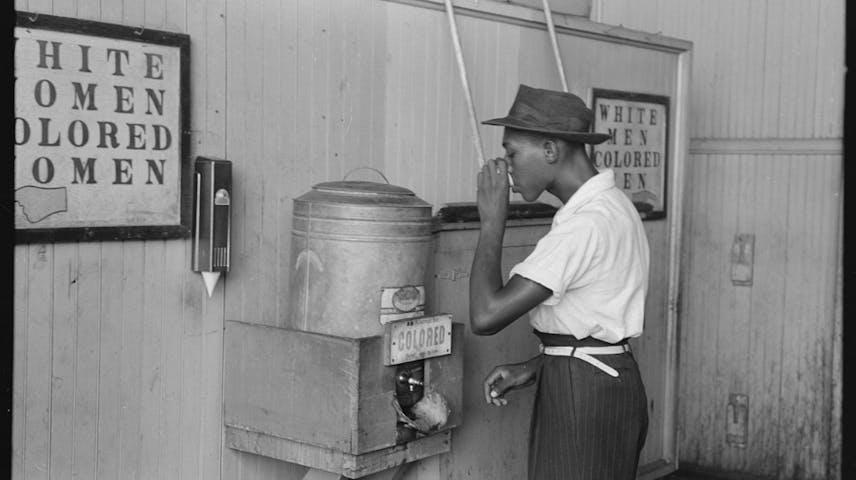
Group 1: After the Civil War: A Promise Broken and What Were Jim Crow Laws? This section of the article describes long-term causes that contributed to the Civil Rights Movement. Racial segregation and the resulting “disenfranchisement” were enforced by law as established in Plessy v. Ferguson. The article explains that Jim Crow laws “were about keeping Black Americans in a position of social and economic inferiority.” As a result, the Black community was forced to endure “racial inequality” that was “legal” and supported by the “United States government.”
Group 2: Laying the Groundwork: The Early Fight for Civil Rights introduces W.E.B. Du Bois, a central player in the fight for civil rights. As “the first Black American to earn a doctorate from Harvard,” he possessed a comprehensive understanding of exactly what rights were violated by the Jim Crow laws and the racial discrimination at the time. He was a leader, working with the Niagara Movement, and then participating in the foundation of the NAACP. These organizations could be considered the actual birth of the Movement, as they took the fight to the public and to the courts, “winning early legal victories that chipped away at segregation.”
Group 3: World War II Changes Everything, and Brown v. Board of Education explain how the war and the court ruling changed expectations and the system. Black Americans came home from the war and “refused to accept Jim Crow the same way they had before.” In response to the inequality, they “became community organizers and activists leading into the Civil Rights Movement.” As a result of the Brown ruling, “Civil rights organizers gained confidence to challenge segregation more directly.”
Group 4: In Emmett Till: A Nation Forced to Look, the author describes the horrifying death of Emmett Till and highlights the injustice of the ruling in favor of his murderers. The injustice and horror of that event “became one of the most powerful catalysts for the Civil Rights Movement.” Rosa Parks and the Montgomery Bus Boycott describes an action that was inspired by the acquittal of Till’s murderers. As a result of Parks’ treatment, a powerful bus boycott ended with a win for civil rights.
Explain that each student needs to be able to describe their assigned section and how the events and conditions contributed to the birth of the Civil Rights Movement in the next part of the lesson.
Pulse Check (RI.8.3) |
|---|
Which statement best explains how the article develops the reasons the Civil Rights Movement was born? A. The article describes the major contributors to the Civil Rights Movement but does not connect those people’s actions.
B. The article describes the laws that enforced racial segregation and builds on the responses to those laws that led to the Civil Rights Movement.
C. The article argues that World War II caused the Civil Rights Movement to begin.
D. The article shows that the movement began only after the Supreme Court ruled against segregation.
|
Transition students into new groups in which each group has one expert representing each section of the article from the previous Jigsaw Reading activity.
Have the student groups create a blank timeline with the following headings to record notes as they discuss each section of the article. Consider providing the students with chart paper or a digital board to recreate the timeline.
1870s | 1890s | 1896 | 1905 | 1909 | 1945 | 1954 | 1955 | 1956 | ||
|---|---|---|---|---|---|---|---|---|---|---|
Say these Directions: Share with your new group what you learned about your section of the article. Explain how the events and conditions in the information you read about contributed to the rise of the Civil Rights Movement. Go in the order that matches the sequence of the article. As you discuss each section in order, collaborate to complete a timeline with years on the top and the description of events, people, and conditions on the bottom.
Explain to students that once they share their knowledge and build the group timeline, they will consider the progression of events that led to the Civil Rights Movement.
SAMPLE RESPONSE:
1870s | 1890s | 1896 | 1905 | 1909 | 1945 | 1954 | 1955 | 1956 | ||
|---|---|---|---|---|---|---|---|---|---|---|
Federal troops leave the South, and white Southern governments regain power after Reconstruction. | Jim Crow laws expanded across the South, enforcing segregation in schools, transportation, restaurants, and public spaces. | In Plessy v. Ferguson, the Supreme Court rules that segregation is legal under the “separate but equal” doctrine. | Du Bois and other Black activists held the Niagara Movement and demanded civil rights. | The NAACP was founded, and the Crisis started reporting on lynchings, racial violence, and injustice | World War II ends; Black veterans face racism at home after fighting for freedom abroad and begin organizing. | The Supreme Court overruled Plessy v. Ferguson in Brown v. Board of Education, giving civil rights leaders more confidence to challenge segregation. | Emmett Till is murdered in Mississippi; his murderers were acquitted and Rosa Parks was arrested for refusing to give up her seat on the bus. | The Montgomery bus boycott begins, and the Supreme Court rules bus segregation unconstitutional. | ||
After students complete the timeline in their jigsaw groups, have the groups discuss the following question:
Ask: How did the progression of events lead to the Civil Rights Movement?
The broken promise of equality in the 1870s, after the Civil War, opened the door for the enactment of laws that “were about keeping Black Americans in a position of social and economic inferiority.” Those laws, called Jim Crow Laws, were further reinforced by the Supreme Court decision in Plessy v. Ferguson. W.E.B. Du Bois, in the meantime, began to speak out against racial injustice, and he eventually worked with other Black activists to demand civil rights. He helped establish the NAACP, an effective organization that publicized the racial violence Black people endured and fought legal battles to undermine segregation and voter “disenfranchisement.” When WWII ended, the discrepancy between the way white people treated Black veterans and the sacrifices those veterans made inspired many people to take action, including veterans who “became community organizers, activists, and leaders.” The Supreme Court ruling in 1954 that “separate but equal” was “unconstitutional” inspired Black communities as it “sent shockwaves through the South” and contributed to organizers challenging “segregation more directly.” The murder of Emmet Till and the acquittal of his murderers “became one of the most powerful catalysts for the Civil Rights Movement.” In direct response to the acquittal, Rosa Parks claimed her seat on a bus, which led to an effective boycott that ended bus segregation.
Invite groups to share their timelines with the class, possibly posting them in the classroom for future reference.
Provide students with a confidence continuum (i.e., 1–5). As needed, model how to demonstrate a level of confidence using the continuum.
Reflection |
|---|
Reflect on your ability to explain the progression of events that led to the Civil Rights Movement using the Reflection routine.
|
Transition students into reflecting on their learning by independently completing a Quick Write response.
Say these Directions: Complete the following Quick Write prompt, identifying one event and its contribution to the formation of the Civil Rights Movement. Use the word disenfranchisement or catalyst if either vocabulary word fits your response.
Today I learned that _____ contributed to the formation of the Civil Rights Movement by _____.
Today I learned that the Civil Rights Movement was decades in the making. Jim Crow laws contributed to the formation of the Civil Rights Movement by creating systemic disenfranchisement that led to a separation of Black and white lives in the South that was “never truly equal.” After decades of enduring Jim Crow, Brown v. Board of Education and Emmett Till’s murder were “catalysts” that ignited the Civil Rights Movement.
Instruct students to reread “Separate and Unequal: Jim Crow and the Road to Civil Rights” in its entirety and take notes in their Journal using the following prompt:
What social and political factors helped the Civil Rights Movement develop in the 1950s? Identify and explain one social factor and one political factor.
Teacher Tip |
|---|
If students need more support in understanding a social or political factor, consider explaining the following:
|
Separate and Unequal: Jim Crow and the Road to Civil Rights
Standard News Bureau